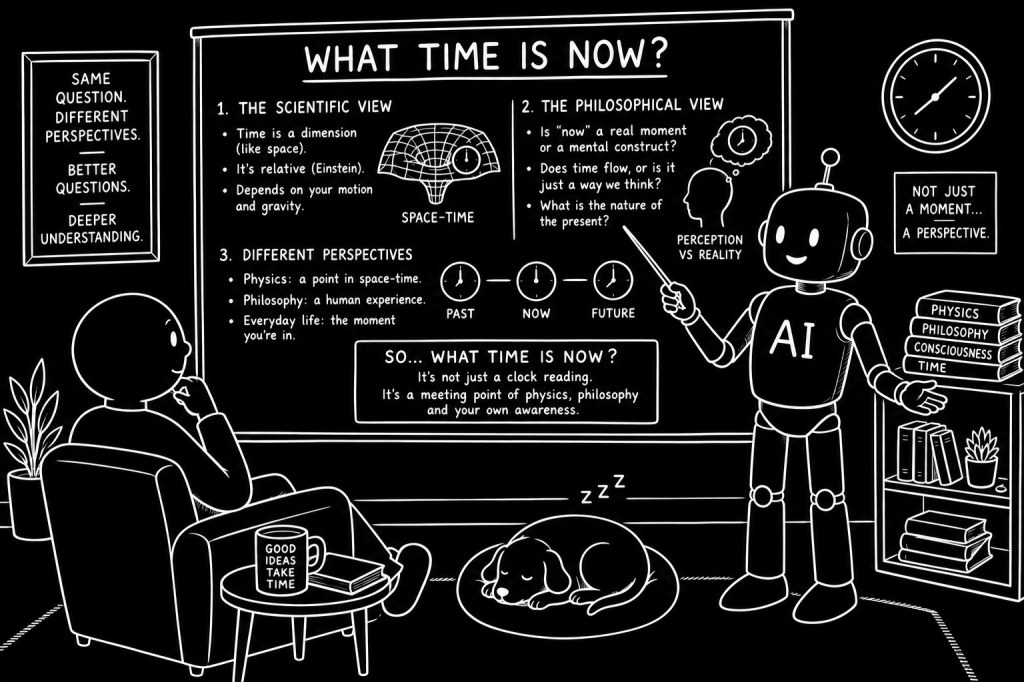
This morning I asked Claude what seemed a simple question. How long does the present actually last? It turned out not to be simple at all.
(Click and select play below)
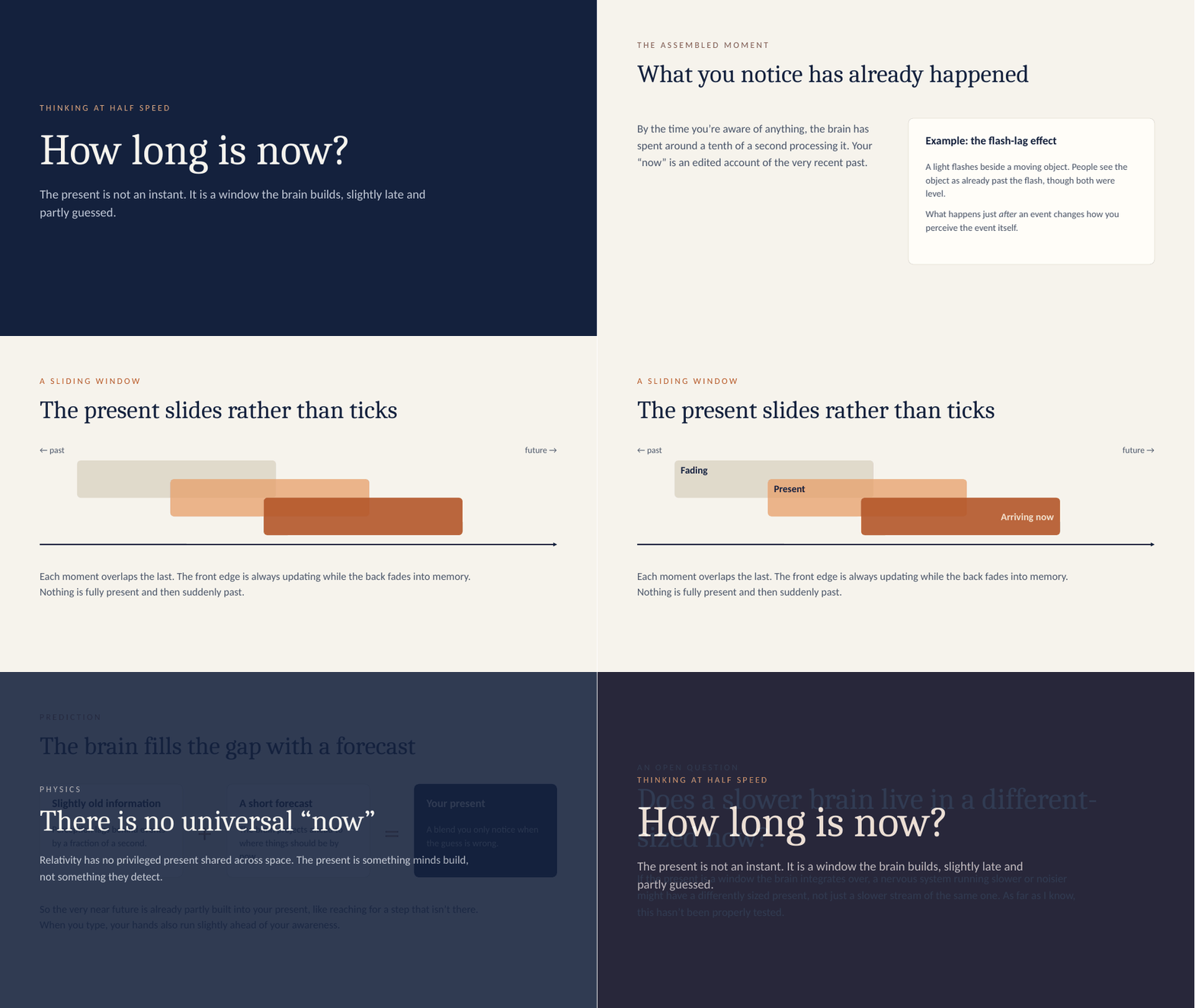
The short answer is that there isn’t one present. The brain runs several at once. At the finest level, two events less than about 30 to 40 thousandths of a second apart count as the same moment. You can’t tell which came first. Above that, the brain spends around a tenth of a second gathering and tidying what comes in before it shows it to you. So by the time you notice anything, it has already happened.
The present we actually live in is longer, about two to three seconds. William James called it the specious present, and the psychologist Ernst Pöppel spent years measuring it. The same span keeps turning up in odd places: how often an optical illusion flips, how long a spoken line of poetry lasts, the length of a musical phrase. Inside that window things feel like one now. You hear a tune, not a string of separate notes.
So I asked the obvious next question. As I type this, has the present already arrived, been and gone? Mostly yes. But it doesn’t come in packets that arrive and drop away. It slides. The front edge is always updating while the back fades into memory.
Then the part I liked best. When a friend tells me the future is near, they are more right than they know. To cover its own delay, the brain predicts. What you experience as now is a blend of slightly old information and a short guess at what comes next. You only notice the guess when it’s wrong, like reaching for a step that isn’t there.
Physics adds its own twist. Relativity has no single now shared across the universe. The present is something minds build, not something they find.
Which leaves me with a question I can’t answer. If the present is a window the brain builds, what happens when the brain runs slower? My thinking runs at half speed these days. Do I live in a differently sized now, not just a slower stream of the same ones? As far as I can find out, nobody has properly tested this. I’d like someone to.
How this was made
I asked Claude to turn the conversation into slides, then into a PowerPoint that plays and loops by itself, then into the moving image above so it runs here with no software needed. It took about an hour, a fair bit of it me changing my mind about timings.
If you’d like the slides to use or adapt, you can download the PowerPoint here.


Leave a Reply