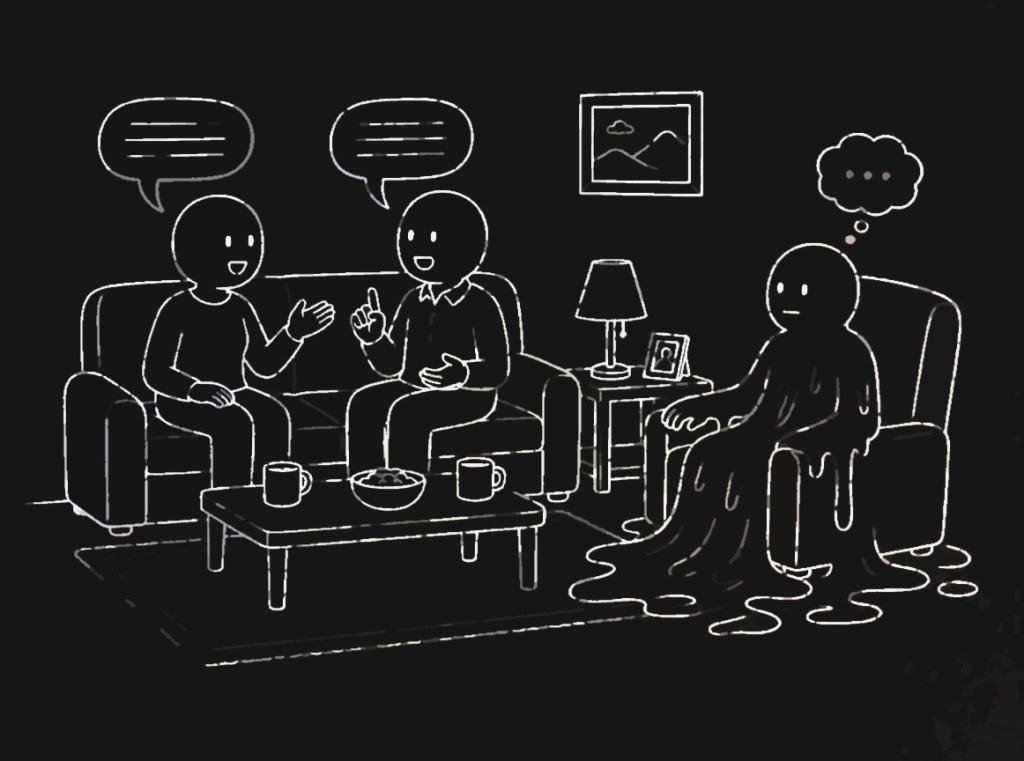
There is a moment I know well. I am mid-conversation — talking, listening, engaged — and then, with very little warning, everything stops working at once. Not just the words. The movement. The thinking. All of it collapses into what I can only describe as a super slow heap. It is not tiredness in any ordinary sense. It is more like a system going offline.
This happens consistently after around an hour of sustained conversation or social engagement. And for a long time I accepted it as just one of those things — a symptom without a clear explanation. Recently I have been trying to understand it properly, partly for myself, and partly because people who care about me deserve a better answer than “I get tired.”
It turns out there is quite a solid explanation. And understanding it has actually helped.
What the Brain is Really Doing During Conversation
Conversation looks effortless from the outside. It is anything but. While you are talking to someone, your brain is simultaneously running multiple demanding processes: decoding incoming speech and turning it into meaning, holding the thread of what was just said in working memory, formulating a response, managing grammar and word selection, coordinating the physical act of speaking, monitoring social cues, and suppressing irrelevant thoughts. All at the same time.
In a healthy brain, this is handled efficiently because there is plenty of capacity and the coordination between systems runs smoothly. In a brain dealing with chronic neurological inflammation, disrupted sleep, and autonomic dysfunction, that coordination is already costing more than it should — and the available capacity is already reduced before the conversation even starts.
The Tank is Never Full
This is the part that took me a while to really sit with.
My nervous system is running a significant background load at all times. Chronic neuroinflammation — the brain’s immune response being persistently activated — consumes energy continuously, not just when I am doing something demanding. Disrupted sleep means the brain’s overnight clearing and repair processes are incomplete. Autonomic dysfunction means that simply maintaining basic functions like blood pressure and circulation takes more active management than it should.
The result is that I start every day, and every conversation, with substantially less in reserve than someone without these conditions. The tank is never full. In fact, it is rarely more than partially full.
Why it Collapses Rather Than Fades
Here is what I find most useful to understand — and most useful to explain to others.
The failure is not gradual. It does not feel like slowly running out of steam. It feels like a circuit breaker tripping. There is a threshold. While the remaining reserve holds, the brain compensates — other areas pick up slack, processing continues, things work. You might not even notice this compensation happening, because it is automatic. But it is expensive.
When the reserve drops below a critical point, the compensation itself fails. And because thinking, speaking, and moving are all coordinated by overlapping central networks, they do not fail one at a time. They fail together. The coordinating layer has gone offline, and everything it was holding up goes with it.
This is why pushing through does not work. It is not a matter of effort or willpower. The resource is genuinely not there to push with.
The Sixty-minute Wall
The consistency of the threshold is not a coincidence. It reflects my current neural reserve — the gap between my compromised baseline and the point at which compensation fails. A gentle, relaxed chat and an intense medical discussion hit roughly the same wall at roughly the same time, because the limiting factor is not the difficulty of the content. It is the overhead of sustained social and cognitive processing against a depleted starting point.
On a better day the wall might come at seventy-five minutes. On a worse day, forty. But it is biology, not effort, that sets it.
What This Means in Practice
The recovery is not quick. Ordinary tiredness — muscle fatigue — clears relatively fast once you rest. Central neurological fatigue requires the brain’s energy metabolism to restabilise, the neuroinflammatory activity to settle, and the autonomic system to return to its resting state. That takes hours. And the resting state I am recovering to is already a compromised baseline, which sits close to the threshold. So the recovery never feels complete, because in a real sense it is not.
This shapes my life in ways that are not always visible. I cannot sustain any socially or cognitively demanding activity beyond around an hour. I cannot chain activities together without significant gaps. Each demand — a conversation, a phone call, even a long piece of reading — draws from the same limited pool. Once that pool is depleted, nothing else is available that day.
The Cruelest Irony: Medical Appointments
There is a particular cruelty built into this for anyone managing a complex neurological condition.
The appointments where you most need to perform well are the ones that most reliably destroy your ability to perform. Everything that makes a medical appointment important also makes it a perfect trigger for collapse. The anticipation and preparation in the days before — already draining the tank before you leave the house. Getting ready on the day. The journey. Waiting in an unfamiliar or clinical environment, often in pain. The stress response that a medical setting produces automatically. And then the appointment itself demanding that you recall complex medical history accurately, articulate symptoms precisely, respond to questions in real time, and advocate for yourself clearly — all simultaneously, under time pressure, under scrutiny.
By the time you are sitting in the chair, you may have already crossed the threshold before anyone has said a word.
I know this because it has happened to me repeatedly. Recently I attended a GP appointment after an hour’s journey that should have taken seven minutes, followed by ninety minutes of waiting in significant pain. By the time I was seen, I was what I can only describe as a jibbering wreck. The doctor — who did not know me — saw someone struggling to communicate, confused, unable to represent themselves clearly. The outcome was a referral to a memory clinic. Based on that consultation, it was a not unreasonable response. Based on who I actually am and what my actual baseline looks like, it missed the point entirely.
That gap — between the observed me and the actual me — is one of the most difficult things to communicate about this condition. The people who most need to see me clearly, clinically, tend to see me at my worst. And the collapse itself, in those settings, looks like exactly the kind of cognitive impairment that might prompt the wrong conclusions.
It is not only medical appointments. Friends visiting, family staying — any sustained social engagement hits the same wall for the same reasons. It does not matter that it is people I love and want to be present for. The mechanism does not care about the emotional significance of the moment. The circuit breaker does not ask whether this is a doctor or a member of my family before it trips.
Why I Can Do This But Not That
Something I get asked, or that people notice without asking: how can someone who struggles to hold a conversation for an hour write like this?
It is a fair question. And the answer is actually quite revealing about what the real bottleneck is.
Writing here — in text, asynchronously, without anyone watching — removes almost every element that triggers the collapse in face-to-face conversation. There is no social overhead: no eye contact to maintain, no facial expressions to read and respond to, no turn-taking signals, no managing how I come across in real time. None of that processing is happening, which means the entire cognitive budget goes to the thinking itself.
There is no time pressure. I can take thirty seconds or thirty minutes between thoughts. Nobody is waiting awkwardly, nobody is misreading a pause as confusion, nobody needs me to fill the silence. The conversation simply holds until I am ready.
I read at my own pace rather than decoding live speech — which for me is already a fragile process. Text just sits there. It does not keep moving while I am still processing the previous sentence.
And if I hit the wall, I can just stop. Close the screen. No explanation needed, no social repair, no one’s feelings to manage. That safety makes it easier to begin in the first place.
What this tells me — and what I think matters clinically — is that the cognitive capacity is there. The bottleneck is not the intellect. It is the overhead of the social and sensory environment that surrounds face-to-face interaction. Strip that overhead away and a conversation that would last forty minutes in person can continue, in this format, for hours.
That distinction is important. It means the person who shows up to a medical appointment struggling to string a sentence together — after a difficult journey, in a clinical environment, in pain, under time pressure — is not an accurate picture of the person underneath. The collapse is real. But so is everything that exists before the collapse happens.
Why I Am Writing This
Not for sympathy. I am writing it because the experience is common among people with chronic neurological conditions, and it is badly understood — including sometimes by the people living it.
It looks, from the outside, like rudeness. Disengagement. Lack of effort. The lights going out mid-conversation are not obvious in the way that a physical symptom is obvious. And the recovery — sitting quietly, doing nothing visibly productive — does not look like recovery.
But it is.
If you have someone in your life who hits a wall like this, the most useful thing I can tell you is: it is real, it is physiological, and it is not about how much they value the conversation. The circuit breaker does not care how important the moment is.
This blog is written with the assistance of Claude. That’s not a footnote — it’s rather the point.


Leave a Reply