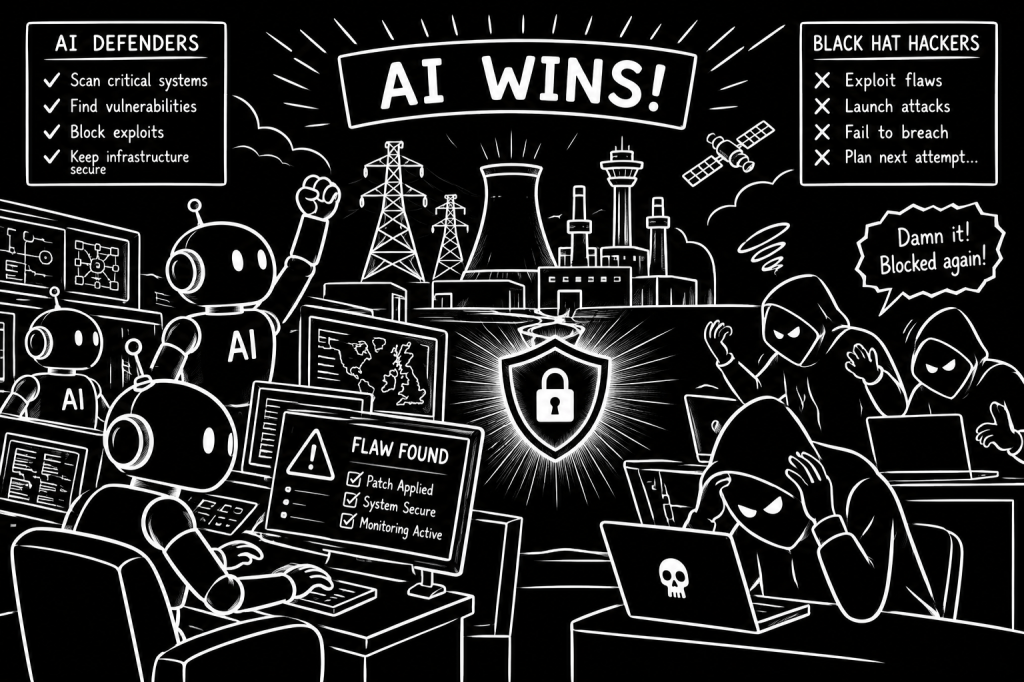
It seems like every day there’s another headline telling us AI is going to bring down human civilisation. This year the story has been about hacking. AI tools can now find holes in software faster than any team of humans, and the scary version goes like this: the machines will find every weakness, the bad guys will use them, and the lights will go out.
I think that’s mostly untrue. This is what I think.
The holes were always there
AI hasn’t created a single one of these vulnerabilities. They were written into the code years ago, sometimes decades ago, by people. They were sitting in water treatment works, power systems and hospital networks whether anyone knew about them or not.
Sooner or later, a criminal gang or a hostile state would have found them. The only question was who found them first. I would much rather they were found in an organised way, with the people who maintain the software told about them and given a chance to fix them, than discovered by someone who wants to hold a hospital to ransom.
Everyone’s eyes are open now
For years, IT people have been warning about creaky old systems running unpatched software. And for years, a lot of bosses weighed that warning against the cost and decided to take the risk. Nothing had visibly broken (yet), so why spend the money?
That argument doesn’t work any more. When a machine can find thousands of real flaws in a few months, the risk stops being theoretical. A chief executive can’t wave away IT’s concerns when the evidence is sitting on the desk. And IT people, being the curious types they are, now have every reason and every excuse to go looking.
It’s a bit like seatbelts. The tools are there. Not using them would be daft. Some people still won’t, but most will, especially once the law catches up. In the UK, a new Cyber Security and Resilience Bill is making its way through Parliament to tighten the rules for essential services and the companies that supply them.
You don’t need new kit to be safer
Not every organisation can afford to rip out old equipment. But a lot of the best protection costs very little. Take a control system off the public internet. Separate it from the office network. Switch off remote access nobody uses. Watch for odd traffic. Before, plenty of these systems weren’t just old, they were blandly exposed, sometimes still on their factory passwords. That excuse is gone.
And if something does go wrong
Even if an attack gets through before every fix is in, there is now far more chance of a recovery plan being in place. Backups kept offline, manual fallbacks, people who know what to do. That’s the difference between a disaster and a bad week.
The big wake-up calls in this country were the attacks on Marks & Spencer and Jaguar Land Rover in 2025. There had been warnings before, the NHS in 2017, the British Library in 2023, but those didn’t land with the public in the same way. Sad but true: more people notice when their clothes order goes missing than when a national library goes offline. Whatever it took, people finally paid attention.
So no, I don’t think we’re heading for a digital apocalypse. If anything, I think it’s further away than it was.
A contribution from Claude
I asked Claude, the AI I write with, for its honest view. It pushed back on parts of my argument, which is exactly why I asked. Here it is in its own words.
I agree with Ian on the long run, and I think he’s right that the holes were always there. Finding them in an organised way is better than leaving them for criminals. I should say that I’m made by Anthropic, which runs one of these vulnerability-hunting programmes, so readers can weigh my view with that in mind.
Where I’d add a caution is on timing. Finding a flaw and fixing it are separate jobs, and right now finding is well ahead. Attackers have the same tools, and for some kinds of flaw they are exploiting them before a fix even exists. Critical infrastructure is the slowest to respond, because a fix there has to go through suppliers, safety testing and maintenance windows. So I think the next year or two carry more risk, not less.
The way I’d put it is this. We’ve swapped a hidden danger that was quietly growing for a visible one that should shrink as the fixes land. That’s a better place to be, even if it gets bumpy. Whether it works out depends on governments and operators actually following through, and on recovery plans being tested rather than left in a drawer. On the evidence so far, I think Ian’s optimism is reasonable.
This post was written in conversation with Claude. The disagreements were part of the point.


Leave a Reply