Over the years I learned to (almost) never say anything honest to specific minds, regarding how their thoughts and beliefs could merely be a trick of the mind. These ideas could quite possibly be a shared delusion, that suits a collective or individual purpose, rather than accurately mapping reality.
What I usually say is something like this: “what you experience as reality — the solid, obvious, self-evident world in front of you — is not a direct feed, it’s a construction.” The brain takes incomplete sensory data and fills in the gaps; predicts what should be there, and then smooths over the inconsistencies. What you get is a very convincing model of the world, yet not the world itself. A hallucination (if you will), in the most technical sense of the word. A very useful one, but a hallucination nonetheless.
Also see: Map-territory relationship (further reading / Wikipedia)
Many people struggle to sit with this idea and I’ve come to understand why.
It’s not just that the idea is uncomfortable. It’s that they’re not only just invested in their own version of reality — they’re invested in a shared one. Think about food. At various points in recent decades, fat was the enemy, then carbs were the enemy, then seed oils were the enemy. Each time, millions of people reorganised their kitchens, their shopping, their identity around the new truth. They told their friends. They evangelised. The belief became social glue.
The same applies to fashion, to fitness culture, to any number of things we collectively decide are true and important. The belief spreads not because the evidence is overwhelming but because belonging to the belief feels good. It’s warm in there. It’s safe.
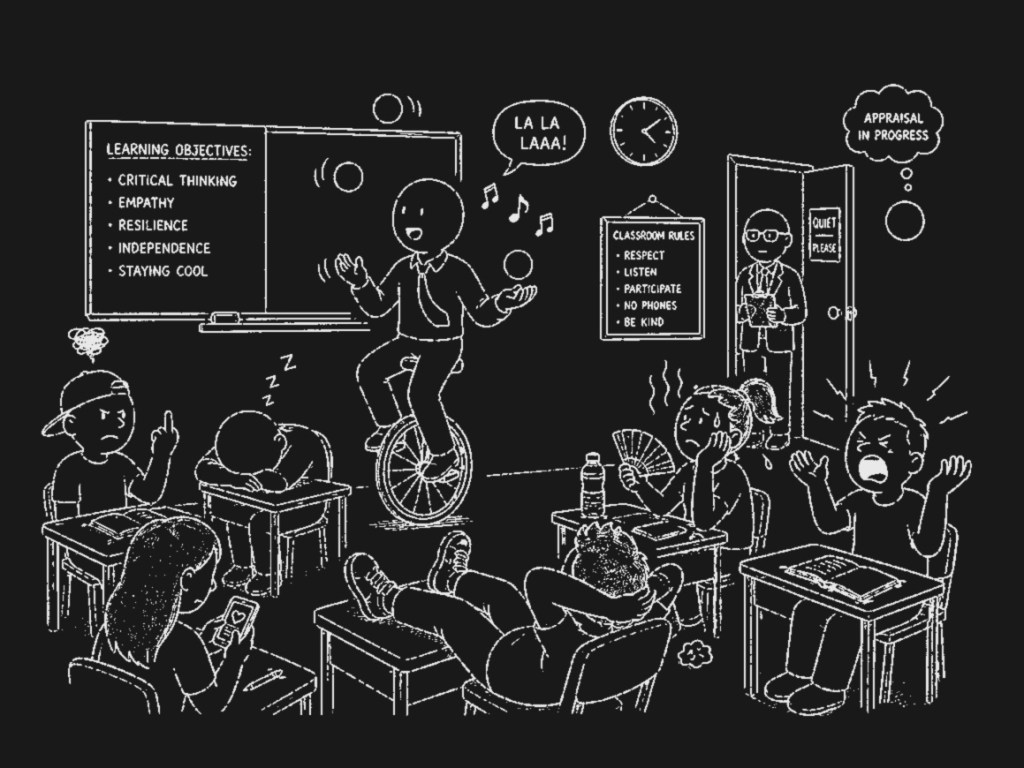
Take teaching. Anyone who has spent time in a classroom knows the rhythm of it — the education consultants arrive, the latest methodology gets adopted, the training days are booked. The teachers in the room often know, at some level, that what works in a carefully selected pilot school will not survive contact with the last lesson of a Year 9 class on a 35°C afternoon, but the school has committed. The quality team attended the course. They need to see it in action in your classroom, right now, or it goes on your appraisal. And the observing staff — who also know, privately, that this won’t work — cannot say so. They’ve invested too much to go back. So everyone performs the belief until next year’s gurus arrive with something new.
And then someone comes along and points at the evidence quietly rotting in the corner.
The problem isn’t that people are stupid. The problem is that they’ve made a social and emotional investment in a particular version of reality, and that investment has compounded over time. The longer you’ve held a belief, the more of yourself you’ve built on top of it. Questioning it doesn’t just mean updating a fact. It means unpicking something load-bearing.
This is what I mean when I say most people are living inside a shared hallucination. Not as an insult. As a description of how minds actually work, operating inside cultures that reinforce each other’s models of the world until those models feel like bedrock.
The bedrock is real to them. That’s what makes it so hard to touch.
This blog is written with the assistance of Claude. That’s not a footnote — it’s rather the point.


Leave a Reply