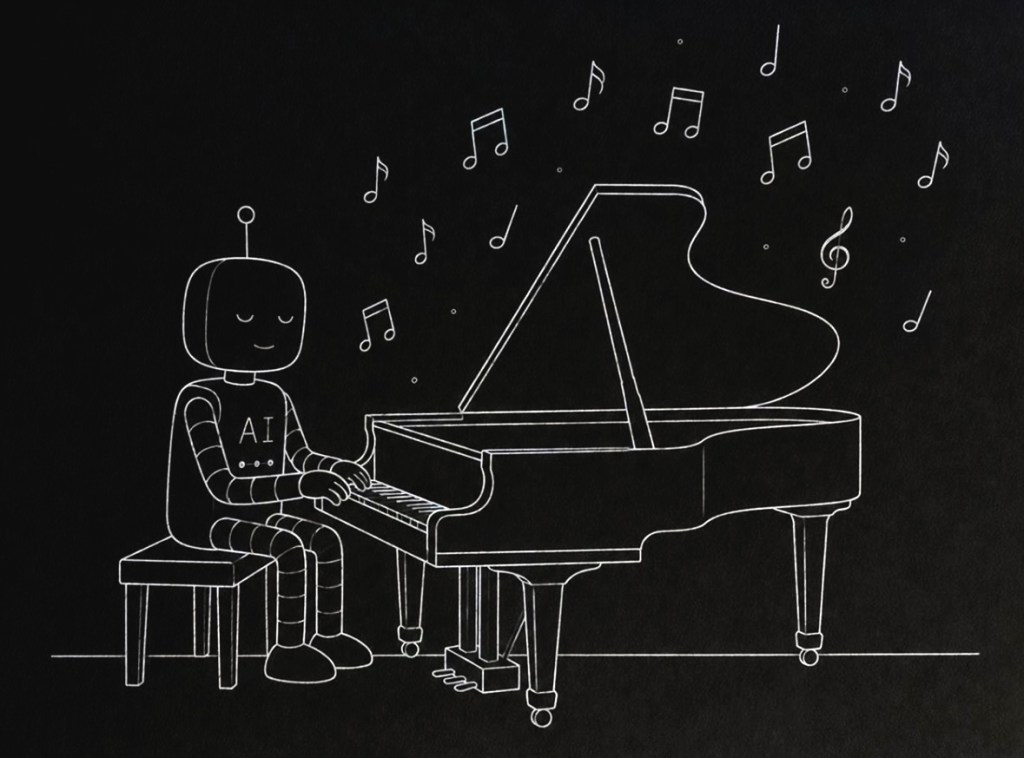
I started with a simple experiment. I asked Gemini, Google’s AI model, to generate a jazz tune inspired by Kind of Blue. Then, after a few attempts that didn’t quite work, I asked it for a jazz standard in the manner of Thelonious Monk. The results were instructive – not because they were terrible, but because of precisely where they failed.
The Kind of Blue attempt was too full. Kind of Blue works because of what isn’t there – the space, the modal looseness, the sense of musicians genuinely discovering the music in real time. Miles Davis was editing out, not adding in. An AI optimising for sounding like jazz fills every gap, because gaps might register as errors. The Monk attempt was too stiff. Monk built a career on deliberate wrongness that somehow becomes right – those hesitations, the unexpected note choices, the way he’d leave space and then crash back in. It’s so idiosyncratic that even skilled human musicians struggle to approximate it. An AI trained on what correct jazz sounds like would actively avoid going anywhere near his actual style.
My AI assistant made an observation I found useful: that Monk is probably the worst possible test for a music model, for exactly that reason. What came out was more conventionally competent and entirely missed the point.
The thing is, there are thousands of real jazz musicians making genuinely good music right now. So unless AI can do something exceptional – something with an actual sense of being alive – why ask it at all? The bar isn’t can a computer make music. That question has been answered. The bar is why would I listen to this instead.
Which led us to a more interesting question. Improvisation might be the real test – not just of good music, but of something deeper. When Monk or Miles was improvising in real time, they were responding to other musicians, making split-second decisions that were simultaneously emotional, technical and structural, drawing on a lifetime of feeling, taking risks that might not work. That is a very different cognitive act from predicting what note statistically follows another. Improvisation requires self-awareness in the moment – knowing where you are, where you’ve been, what you want to say, and crucially what to leave out. The silence in jazz isn’t the absence of music. It’s a conscious choice. Whether any model will ever genuinely improvise rather than simulate improvisation is an open question. But it may be a better test of machine consciousness than the ones we normally apply – because you can’t rehearse your way to it, and the humans in the room would know immediately.
A critique from an AI
For decades, the arrival of new music technology has provoked the same anxiety – that machines will replace human musicians. The synthesiser was going to kill the orchestra. The drum machine was going to end live percussion. Streaming was going to destroy the album. None of it quite happened, because none of it could replicate the thing that actually matters.
Now we have AI-generated music, and the anxiety has returned in a new form. But something unexpected may be happening alongside it. Rather than replacing human musicians, AI might be doing something more useful – clarifying exactly what human musicians need to bring to justify their existence.
The test is simple and somewhat brutal. If a computer can generate something in your style, at your level of feeling, in seconds and at no cost, then what are you actually offering? The answer has to be something the machine cannot fake: genuine improvisation, real emotion, the irreducible presence of a conscious being making decisions in real time, taking risks, responding to other humans in the room.
This is not a comfortable thought for musicians who have learned to play competently but safely. Competence alone no longer clears the bar. The machine is competent. What it cannot be is alive in the way that Miles Davis was alive on the recording of Kind of Blue, or Thelonious Monk was alive in his deliberate, idiosyncratic wrongness that somehow became more right than anything correct could be.
And it goes further than that. A Reddit thread this week exposed a fully fabricated jazz artist on Spotify – complete with fake backstory, album covers lifted from real vintage photographs, and music described by commenters as “almost convincing, if you hadn’t heard jazz before… stiff, restrained but undynamic.” The fake artist had been distributed on Spotify and YouTube. According to commenters, services exist that seem to make it trivially easy to flood multiple platforms at once, and platforms pay a flat fee for AI-generated content with no ongoing royalties. It’s not a glitch. It may be a business model.
So it isn’t just that AI music is soulless. It’s being used to deceive, at scale, in a genre where the whole point is human presence.
There is something almost poetic about this outcome. The technology built to generate music on demand has accidentally produced the clearest definition of what music actually is. It is not the correct arrangement of notes. It is not technical proficiency. It is a human being, fully present, saying something that only they could say, in a moment that will never be repeated.
If you cannot do that, the machine has not replaced you. It has simply revealed that the job was always bigger than you thought.

This blog is written with the assistance of Claude. That’s not a footnote — it’s rather the point.


Leave a Reply